4 posts tagged with "ai-infrastructure"

View All Tags

AI Cost Firewall: An OpenAI-Compatible Gateway That Cuts LLM Costs by 75%

· 9 min read
Founder of VCAL Project

Originally published on Dev.to on March 16, 2026.
Read the Dev.to version

Exact + semantic caching for AI applications


In today’s era of AI adoption, there is a distinct shift from integrating AI solutions into business processes to controlling the costs, be it the costs of a cloud solution, a local LLM deployment, or the cost of tokens spent in chatbots. If your solution includes repeated questions and uses an OpenAI-compatible model, and if you are looking for a simple, free and effective way to immediately cut your company’s daily token costs, there is one infrastructural solution that does it right out of the box.

AI Cost Firewall is a free open-source API gateway that decides which requests actually need to reach the LLM and which can be answered from previous results without additional token costs.

The gateway consists of a Rust-based firewall “decider”, a Redis database, a Qdrant vector store, Prometheus for metrics scraping, and Grafana for monitoring. All the tools are deployed with a single docker compose command and are available for use in less than a minute.

Once deployed, AI Cost Firewall sits transparently between your application and the LLM provider. Your chatbot, AI assistant, or internal automation continues to send requests exactly the same way as before with the only difference that the API endpoint now points to the firewall instead of directly to the model provider. The firewall then performs an instant check before deciding whether the request should actually reach the LLM and raise your monthly bill.


How the firewall reduces token costs

AI Cost Firewall eliminates unnecessary token spends using two layers of caching.

Exact match cache (Redis / Valkey)

The first step is an extremely fast exact request match check. Each incoming request is normalized and hashed. If an identical request was previously processed, the firewall immediately returns the stored response from Redis. This lookup takes microseconds and costs zero tokens. For workloads with frequent identical prompts such as customer support or internal documentation assistants this alone can already reduce a significant portion of LLM traffic.

Semantic cache (Qdrant)

The second layer addresses the case of semantic similarity: questions are similar but not identical.

For example:

User A: Provide a one-sentence explanation of what Kubernetes is.
User B: What is Kubernetes? Give me a one-sentence explanation.

Even though the wording differs, the semantic value and thus meaning of these questions is essentially the same (if you are interested in what semantics in AI is, have a look at my article From words to vectors: how semantics traveled from linguistics to Large Language Models).

To detect these situations, AI Cost Firewall uses a semantic vector search. Each request is embedded using a lightweight embedding model, and the resulting vector is compared against previously stored queries using Qdrant, a high-performance vector database designed specifically for this. If the similarity score exceeds a certain threshold, the firewall returns the previously generated answer instead of sending the request to the LLM again. In this way, a single LLM response can be reused dozens or even hundreds of times without extra tokens expense.

Forwarding only when necessary

If neither the exact cache nor the semantic cache contains a suitable answer, the firewall forwards the request to your upstream model provider. Besides being provided to the user, the returned response is then stored in both Redis and Qdrant for future reuse. The workflow therefore becomes (simplified):

Client → AI Cost Firewall

Redis check

Qdrant semantic check

(only if needed)

LLM API

The LLM is only called when a genuinely new question appears.

With this approach, the AI Cost Firewall does not only save the costs but also rockets the response time improving the users’ satisfaction (Customer Satisfaction Score, CSAT).


OpenAI compatible by design

One of the most practical aspects of AI Cost Firewall is that you do not have to touch your application to integrate it. What you do is you simply switch the base URL to the firewall’s endpoint:

client = OpenAI(
base_url="http://localhost:8080/v1"
)

From the application’s perspective, nothing changes. The same requests and responses flow through the system. However, now the firewall intelligently “decides” whether the model actually needs to be called and the money has to be spent.

This tool is compatible with:

  • OpenAI models
  • Azure OpenAI
  • local OpenAI-compatible servers
  • many hosted inference platforms

In other words, any system that already works with the OpenAI API can immediately benefit from cost reduction. And more than that, other models are going to be added soon by the project developers.


Observability built in

One of the integrated features of the AI Cost Firewall is its built-in monitoring. It consists of Prometheus for scraping the metrics and integrated Grafana Dashboard. Both services are launched automatically by docker compose using preconfigured Prometheus YAML and a prebuilt Grafana dashboard JSON, so the monitoring stack is ready immediately without any manual configuration.

Prometheus metrics allow you to track:

  • number of cache hits
  • semantic matches
  • forwarded requests
  • estimated cost savings
  • active requests

You can immediately visualize these metrics with the Grafana dashboard to see exactly how much the firewall is saving in real time (with a 5-second delay to be honest).


Why it works well

AI Cost Firewall works because it targets a structural characteristic present in almost every LLM application:

  • repeated user questions
  • overlapping knowledge queries
  • duplicated agent prompts

By caching responses and using semantic similarity search, the system converts repeated LLM calls into near-zero-cost lookups.

Why near-zero and not fully zero? Because semantic matching still requires generating embeddings for incoming queries. However, embedding costs are typically orders of magnitude lower than generating full LLM responses.

Another advantage of the firewall is its intentionally minimal architecture:

  • Rust firewall gateway
  • Redis for exact caching
  • Qdrant for semantic caching
  • Prometheus + Grafana for monitoring

This simplicity makes it easy to deploy, maintain, and scale.


When AI Cost Firewall is most effective

The biggest savings with AI Firewall occur in systems where similar questions appear frequently. You will immediately benefit from the AI Cost Firewall integration if your system includes any or several of the following components:

  • customer support chatbots
  • internal company knowledge assistants
  • documentation Q&A systems
  • developer copilots
  • AI help desks
  • AI Agents performing any of the above tasks

In these environments, the same core questions appear repeatedly across many users. Even when questions are phrased differently, the semantic cache can reuse the same answer multiple times.

Advanced users may also appreciate the integrated TTL (Time-to-Live) feature which allows you to set up the duration of the response kept in Redis’s memory before replaced with a newly generated one. The same feature for Qdrant is currently under development and will be introduced soon.


Try it in 60 seconds

If you want to see how AI Cost Firewall works, you can deploy the whole stack locally or on a small server in less than a minute.

Example:

git clone https://github.com/vcal-project/ai-firewall
cd ai-firewall
cp configs/ai-firewall.conf.example configs/ai-firewall.conf
nano configs/ai-firewall.conf # Replace the placeholders with your API keys
docker compose up -d

This launches:

  • AI Cost Firewall
  • Redis (exact cache)
  • Qdrant (semantic cache)
  • Prometheus (metrics scraping)
  • Grafana (monitoring dashboard)

Once the containers start, simply point your OpenAI client to:

http://localhost:8080/v1

Within seconds, the gateway is ready to accept OpenAI-compatible requests. Similar to Nginx and other infrastructure gateways, you only need to add your API keys to the configuration file. From that point on, every request automatically passes through the cost-saving pipeline while previous responses are stored in Redis and Qdrant for future reuse.

Because the gateway itself is stateless, multiple firewall instances can be deployed behind a load balancer, allowing the system to scale horizontally with growing traffic.

                         ┌───────────────────────┐
│ Clients │
│ Chatbots / Agents / │
│ Internal AI Apps │
└───────────┬───────────┘


┌───────────────────────┐
│ Load Balancer │
│ Nginx / HAProxy │
└───────────┬───────────┘

┌────────────────────┼────────────────────┐
│ │ │
▼ ▼ ▼
┌──────────────────┐ ┌──────────────────┐ ┌──────────────────┐
│ AI Cost Firewall │ │ AI Cost Firewall │ │ AI Cost Firewall │
│ instance 1 │ │ instance 2 │ │ instance 3 │
└─────────┬────────┘ └─────────┬────────┘ └─────────┬────────┘
│ │ │
└─────────────┬───────┴───────────┬─────────┘
│ │
▼ ▼
┌──────────────────┐ ┌──────────────────┐
│ Redis / Valkey │ │ Qdrant │
│ Exact cache │ │ Semantic cache │
└─────────┬────────┘ └─────────┬────────┘
│ │
└──────────┬───────────┘


┌───────────────────────┐
│ Upstream LLM API │
│ OpenAI / Azure / vLLM │
└───────────────────────┘


┌─────────────────────── Observability Stack ─────────────────┐
│ │
│ AI Cost Firewall metrics ─────► Prometheus ─────► Grafana │
│ │
└─────────────────────────────────────────────────────────────┘

Architecture of a horizontally scalable AI Cost Firewall deployment.


Conclusion

With the growing adoption of AI, it is sometimes painful to watch the steady increase of company expenses related to LLM tokens. Large Language Models are extremely powerful, but they can also become quite expensive when used at scale. It feels even more unfair when you realize that a significant portion of LLM traffic consists of repeated or semantically similar questions.

AI Cost Firewall addresses this inefficiency with a simple idea: do not send the same or similar question to the model again and again. Instead, reuse answers that were already generated for identical or semantically similar queries.

By combining exact caching with semantic similarity search, the firewall allows previously generated answers to be reused safely and efficiently. The result is lower token consumption, faster responses, and reduced infrastructure costs.

Because the gateway is OpenAI-compatible, integration requires only a small configuration change. No application refactoring is needed. If your system includes chatbots, knowledge assistants, developer copilots, or AI agents that answer recurring questions, AI Cost Firewall can reduce token usage by 30–75% immediately after deployment.

And since the entire stack runs with a single docker compose command, you can try it in minutes.

Sometimes the most effective optimization is not a new model, a larger GPU cluster, or a complex architecture.

Sometimes it is simply not paying twice for the same answer.


If you find this open-source project useful, a GitHub star will help the project grow.

https://github.com/vcal-project/ai-firewall

From Words to Vectors: How Semantics Traveled from Linguistics to Large Language Models

· 8 min read
Founder of VCAL Project

Originally published on Dev.to on January 17, 2026.
Read the Dev.to version

Why meaning moved from definitions to structure — and what that changed for modern AI


When engineers talk about semantic search, embeddings, or LLMs that "understand" language, it often sounds like something fundamentally new. Yet the problems modern AI systems face — meaning, reference, ambiguity, and context — were already central questions in linguistics and philosophy more than a century ago.

This article traces how the concept of semantics evolved across disciplines: from linguistics and philosophy, through symbolic AI and statistical NLP, and finally into the neural architectures that power modern large language models, and why this history matters for how we design retrieval, memory, and language systems today. The journey reveals that today's AI systems are not a break from the past, but the convergence of long-standing ideas finally made computationally feasible.


Linguistic Origins: Meaning as a System, Not a Label

Modern semantics begins not with computers, but with language itself. In the late 19th and early 20th centuries, linguists began to reject the naive idea that words simply "point" to things in the world. One of the most influential figures in this shift was Ferdinand de Saussure, who argued that language is a structured system of signs rather than a naming scheme.

Saussure proposed that each linguistic sign consists of two inseparable parts: the signifier (the sound or written form) and the signified (the concept evoked). Crucially, the relationship between the two is arbitrary. There is nothing inherently "dog-like" about the word dog. Its meaning arises because it occupies a position within a broader system of contrasts: dog is meaningful because it is not cat, not wolf, not table.

This was a radical idea at the time. Meaning, Saussure claimed, is relational. Words derive significance from how they differ from other words, not from direct correspondence with reality. This insight quietly laid the conceptual groundwork for everything from structural linguistics to modern vector-based representations.


Philosophy of Language: Meaning, Logic, and Composition

While linguists focused on structure, philosophers sought precision. In particular, Gottlob Frege transformed semantics by embedding it into formal logic. Frege introduced a critical distinction between sense — the mode of presentation of an idea, and reference — the actual object being referred to.

This distinction explained how two expressions could refer to the same thing while conveying different information. "The morning star" and "the evening star" both refer to Venus, yet they are not interchangeable in all contexts. Meaning, therefore, could not be reduced to reference alone.

More importantly, Frege formalized the idea of compositionality: the meaning of a sentence is determined by the meanings of its parts and the rules used to combine them. This principle became foundational not only in philosophy, but later in programming languages, logic systems, and early AI models.

In retrospect, compositionality is what allowed meaning to be treated as something computable, at least in theory.


Early Artificial Intelligence: When Meaning Was Symbolic

When I studied linguistics at university many years ago, everything up to this point was already part of the curriculum. Structural linguistics, philosophy of language, and formal semantics provided a solid theoretical foundation. What none of us could have anticipated at the time was how directly these ideas would later intersect with computer science in what would come to be called artificial intelligence.

When AI emerged as a field in the mid-20th century, it inherited philosophy's confidence in symbols and logic. Early systems assumed that meaning could be explicitly represented through formal structures: symbols, predicates, rules, and ontologies. To "understand" language was to transform symbols according to carefully designed rules.

For a while, this worked. Expert systems, knowledge graphs, and first-order logic engines achieved impressive results in narrowly defined domains such as medical diagnosis, chemical analysis, and configuration problems. Within carefully bounded worlds, symbolic semantics appeared tractable.

Natural language, however, quickly exposed the limits of this approach. Human language is ambiguous, context-dependent, and constantly evolving. Encoding all possible meanings and interpretations proved not merely difficult, but fundamentally unscalable. Symbolic systems were brittle: they failed not gradually, but catastrophically, when faced with inputs that deviated even slightly from their assumptions.

Semantics, it turned out, was far messier than logic had allowed, and far more resistant to being fully written down.


The Statistical Shift: Meaning Emerges from Usage

A quiet revolution began when linguists and computer scientists started to look not at rules, but at usage patterns. The idea that meaning could be inferred from how words are used rather than how they are defined gained traction in the mid-20th century.

The core insight was simple but profound: words that appear in similar contexts tend to have similar meanings. Instead of encoding semantics explicitly, one could measure it statistically by analyzing large corpora of text.

This approach, known as distributional semantics, reframed meaning as something empirical rather than prescriptive. Words became vectors of co-occurrence statistics. Similarity was no longer binary or rule-based, but graded and approximate.

This was a decisive break from symbolic AI and a return, in spirit, to Saussure's relational view of meaning.


Word Embeddings: Geometry Becomes Semantics

Distributional ideas matured dramatically with the introduction of neural word embeddings, particularly models like Word2Vec. Instead of relying on sparse frequency counts, these models learned dense, low-dimensional vector representations optimized to predict linguistic context.

What emerged surprised even their creators. Semantic relationships appeared as geometric regularities in vector space. Differences between vectors encoded analogies, hierarchies, and semantic proximity. Meaning became something you could measure with cosine similarity.

This was not symbolic understanding, but it was not random either. It was structure: learned rather than designed.

For the first time, machines exhibited behavior that looked like semantic intuition, despite having no explicit definitions or rules.


Contextual Semantics: Meaning Is Not Fixed

Static embeddings had a fundamental limitation: each word had exactly one vector, regardless of context. But human language does not work that way. The meaning of a word shifts depending on surrounding words, speaker intent, situation, and even emotion.

Transformer-based models, particularly BERT, addressed this by making representations contextual. Instead of asking "What does this word mean?", the model learned to ask "What does this word mean here?"

Through attention mechanisms, transformers model relationships between tokens dynamically. Meaning is no longer stored in a single vector per word, but distributed across layers and activations that respond to context.

This marked a crucial step toward pragmatic semantics: language as it is actually used, not as it is abstractly defined.


Large Language Models: Semantics as Emergent Structure

Large language models such as GPT do not contain explicit semantic representations in the traditional sense. They are trained to predict the next token in a sequence. And yet, at scale, they display behaviors that look strikingly semantic: summarization, reasoning, translation, abstraction.

The key idea is emergence. As models compress vast amounts of linguistic data, they internalize regularities about the world, language, and human communication. Semantics arises not as a module, but as a side effect of learning efficient representations.

These models do not "know" meaning in a philosophical sense. But they operate in a space where syntax, semantics, and pragmatics are inseparable, and where relational structure dominates.


When Meaning Becomes Operational

For practitioners building semantic search systems, RAG pipelines, or LLM-adjacent infrastructure, this history is not academic background — it is an explanation of why certain designs consistently work while others fail. Exact matching breaks down because natural language rarely repeats itself verbatim. Embeddings succeed not because they are clever, but because they mirror how meaning behaves in practice: approximately, relationally, and with tolerance for variation.

Once this is understood, several architectural consequences follow naturally. Retrieval quality depends less on perfect recall and more on selecting representations that preserve semantic neighborhoods. Caching strategies become viable only when equivalence is defined by similarity rather than identity. Evaluation metrics must account for graded relevance instead of binary correctness. Even system boundaries shift: components no longer exchange "facts", but approximations of meaning that remain useful within context.

Semantic systems are effective precisely because they do not attempt to eliminate ambiguity. They absorb it. Whether you are designing a vector store, placing a semantic cache in front of an LLM, or building a long-term memory layer for conversational systems, you are implicitly making choices about how much approximation your system tolerates and where that tolerance is enforced.


Closing Thought: Semantics as Shared Infrastructure

What began as a linguistic insight, that words gain meaning through their relations to other words, has quietly become an organizing principle for entire computational systems. Meaning no longer lives in dictionaries, rules, or symbols, but in patterns: in how expressions cluster, diverge, and reappear across vast landscapes of language. Semantics is no longer something a system contains; it is something a system moves through.

This shift took more than a century to unfold. It required philosophers to separate sense from reference, linguists to abandon naming theories, and engineers to accept approximation over certainty. Only when data became abundant and computation relatively cheap did this long trajectory converge into something operational. Semantics, once debated in lecture halls and footnotes, has become infrastructure — implicit, distributed, and shared.

That idea, radical when first proposed, has been waiting over a hundred years for enough data and compute to become practical.

And now, finally, it has.

Beyond Vector Databases: The Case for Local Semantic Caching

· 6 min read
Founder of VCAL Project

Originally published on Medium.com on November 6, 2025.
Read the Medium.com version

Cover

When “intelligence” wastes cycles

Most teams building LLM-powered products eventually realize that a large portion of their API costs come not from new insights, but from repeated questions.

A support bot, an internal assistant, or an analytics copilot, all encounter thousands of near-identical queries:

“How do I pass the API key to the local model gateway?”
“Why is the dev database connection timing out?”
“How can I refresh the cache without restarting the service?”

Each of those prompts gets re-tokenized, re-embedded, and re-sent to an LLM even when the model has already answered an equivalent question a minute earlier.

What do we have as a result? Burned tokens, wasted latency, and duplicated reasoning.

Vector databases solved storage, not reuse

The industry's first instinct was to throw vector databases at the problem. They excel at persistent embeddings and semantic retrieval, but they were never built for reuse. What they lack are TTL policies, eviction strategies, and atomic snapshotting of in-flight state. In other words, they store knowledge, not memory.

Traditional vector databases follow a key:value paradigm: they persist embeddings indefinitely so they can be queried later, much like records in a datastore. A semantic cache, by contrast, treats embeddings as dynamic memory — governed by similarity, expiration, and adaptive retention. Its goal is not to archive information, but to avoid redundant reasoning across millions of semantically similar requests.

With a semantic cache such as VCAL, cached answers can stay valid for days or weeks, depending on data volatility and TTL settings. This moves caching from short-term repetition avoidance to long-horizon semantic reuse where reasoning itself becomes a reusable resource rather than a recurring cost.

In essence, VCAL bridges the gap between data retrieval and cognitive efficiency, turning past computation into future acceleration.

From data stores to memory layers

In my previous Dev.to article, I explained how we built VCAL, a Rust-based semantic cache that sits between your app and the LLM. Instead of persisting every vector, it memorizes embeddings for a short time, indexed by semantic similarity and metadata.

When a new query arrives, VCAL compares it to cached vectors. If it is close enough — a cache hit — the LLM call is skipped, and the stored answer is returned in milliseconds. Otherwise, the request proceeds normally, and the response is stored for future matches.

The design combines concepts from vector search and traditional caching systems, enhanced with features for resilience and monitoring:

  • HNSW index for ultra-fast approximate similarity search.
  • TTL and LRU eviction for automatic cache turnover.
  • Snapshotting for persistence between restarts.
  • Prometheus metrics for observability.

All of it runs on-prem, next to your model or gateway with no remote dependencies.

Why local caching changes the economics

Unlike vector databases, a local semantic cache has one simple purpose: avoid redundant reasoning. Each avoided LLM call translates directly into saved tokens, lower API bills, and shorter response times.

In real deployments we’ve seen:

  • 30–60 % reduction in LLM calls
  • Millisecond-level latency on repeated queries enabling near-real-time responsiveness
  • Predictable resource usage: no external round-trips, no cloud egress costs, and no multi-tenant contention

At scale, the more your users interact, the greater the savings become. Instead of paying per token for every repetition, you amortize prior reasoning across sessions and teams.

And because VCAL runs inside your private environment, all caching and embeddings stay under your control ensuring data privacy, compliance, and deterministic performance even in regulated industries.

A new layer in the AI stack

If you visualize the modern LLM stack, the simplified design looks like this:

User → Application → LLM Gateway → Model

or, if a RAG (Retrieval-Augmented Generation) framework is involved:

User → Application → Retriever → Vector DB → (context) → LLM Gateway → Model

Adding a semantic cache such as VCAL introduces this new dimension:

User → Application → Retriever → Vector DB → (context) → Semantic Cache → LLM Gateway → Model

Here, the cache checks whether a semantically equivalent query was already answered. If found, the response is returned instantly — skipping tokenization, embedding, and inference altogether. If not, the request continues as usual, and the new answer is stored for future reuse.

Vector databases still matter but they belong to the knowledge layer, not the inference path. What has been missing so far is a memory layer that prevents repeated reasoning altogether. Semantic caching fills the missing “memory” slot in between. It is not a replacement for RAG, it is a complement. While RAG injects context, caching avoids duplication.

Engineering for low latency

Achieving millisecond response times in semantic caching requires more than just a fast similarity search algorithm. It’s the result of careful coordination between data structures, memory layout, and concurrency control.

The cache can be implemented efficiently in systems programming languages such as Rust, using an HNSW-based index for approximate nearest-neighbor search. HNSW provides logarithmic-scale query complexity while maintaining accuracy for large collections of embeddings, making it suitable for workloads that reach millions of cached entries.

Low latency also depends on predictable memory management and lock-free or fine-grained synchronization between threads. Instead of allocating and freeing vectors dynamically, embeddings are often stored in preallocated arenas or memory-mapped regions to minimize fragmentation and system calls. Parallel workers can update the index or evaluate similarity thresholds concurrently, so that retrieval scales with the number of available cores.

In practice, a semantic cache can be deployed as a lightweight service beside an inference gateway, communicating over local HTTP or gRPC. It can also be embedded directly into an application process when minimal overhead is required, for example, within an agent runtime or API handler.

The bigger picture

Caching has always been an invisible driver of performance — from CPU registers that reuse instructions, to CDNs that reuse content, to databases that reuse queries.

Each generation of systems extends the notion of what can be reused. As language models enter production, we are witnessing a shift toward semantic reuse: reusing meaning rather than data. This enables systems to recall previous reasoning instead of repeating it — a step toward more efficient and sustainable AI infrastructure.

In this new layer of the AI stack, semantic caching becomes a form of reasoning memory: it stores the results of understanding, not just storage operations. Instead of recomputing the same insight across thousands of near-identical prompts, we can recall it instantly — with full control over latency, privacy, and cost.

Further reading

For readers interested in implementation details and open-source examples:


Thank you for reading! Semantic caching is still an emerging concept — every real-world use case helps shape how we think about efficient reasoning. Share yours in the comments if you’d like to join the conversation.

How I Created a Semantic Cache Library for AI

· 4 min read
Founder of VCAL Project

Originally published on Dev.to on October 27, 2025.
Read the Dev.to version

Cover

Have you ever wondered why LLM apps get slower and more expensive as they scale, even though 80% of user questions sound pretty similar? That’s exactly what got me thinking recently: why are we constantly asking the model the same thing?

That question led me down the rabbit hole of semantic caching, and eventually to building VCAL (Vector Cache-as-a-Library), an open-source project that helps AI apps remember what they’ve already answered.


The “Eureka!” Moment

It started while optimizing an internal support chatbot that ran on top of a local LLM. Logs showed hundreds of near-identical queries:

“How do I request access to the analytics dashboard?”
“Who approves dashboard access for my team?”
“My access to analytics was revoked — how do I get it back?”

Each one triggered a full LLM inference: embedding the query, generating a new answer, and consuming hundreds of tokens even though all three questions meant the same thing.

So I decided to create a simple library that would embed each question, compare it to what was submitted earlier, and if it’s similar enough, return the stored answer instead of generating an LLM response, all this before asking the model.

I wrote a prototype in Rust — for performance and reliability — and designed it as a small vcal-core open-source library that any app could embed.

The first version of VCAL could:

  • Store and search vector embeddings in RAM using HNSW graph indexing
  • Handle TTL and LRU evictions automatically
  • Save snapshots to disk so it could restart fast

Later came VCAL Server, a drop-in HTTP API version for teams that wanted to cache answers across multiple services while deploying it on-prem or in a cloud.

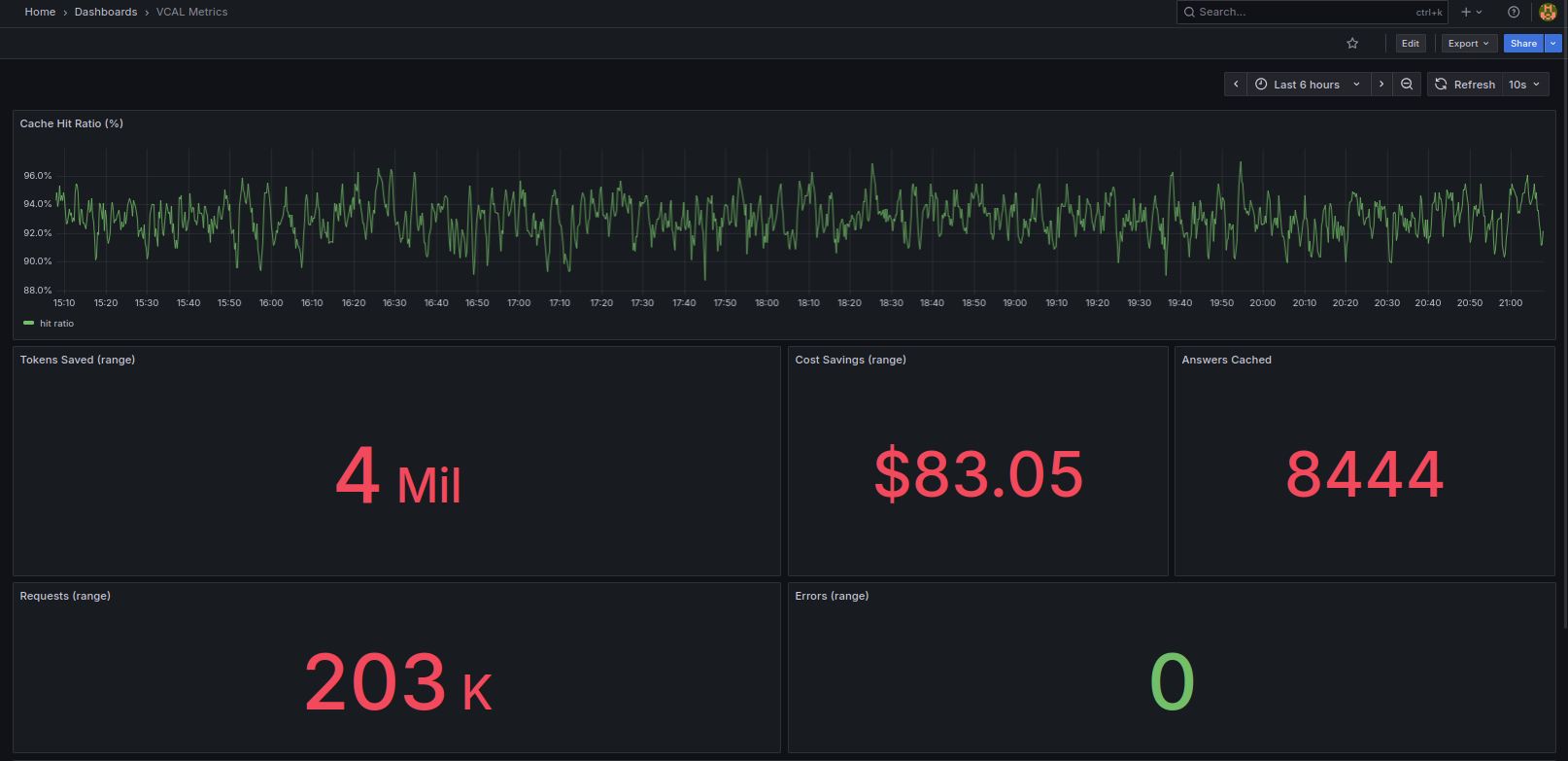
Screenshot: Grafana dashboard showing cache hits and cost saving


What It Feels Like to Use

Unlike a full vector database, VCAL isn’t designed for long-term storage or analytics. I didn’t want to build another vector database.
VCAL is intentionally lightweight. It is a fast, in-memory semantic cache optimized for repeated LLM queries.

Integrating VCAL takes minutes.
Instead of calling the model directly, you send your query to VCAL first.
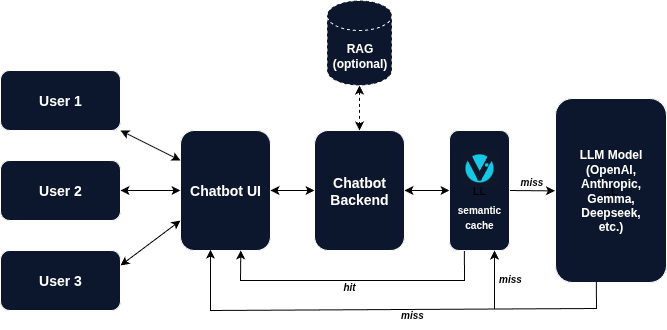
If a similar question has been asked before — and the similarity threshold can be tuned — VCAL returns the answer from its cache in milliseconds. If it’s a new question, VCAL asks the LLM, stores the result, and returns it.
Next time, if a semantically similar question comes in, VCAL answers instantly.

It’s like adding a memory layer between your app and the model — lightweight, explainable, and under your full control.

Flow diagram: user → VCAL → LLM


Lessons Learned

  • LLMs love redundancy. Once you start caching semantically, you realize how often people repeat the same question with different words.
  • Caching semantics ≠ caching text. Cosine similarity and vector distances matter more than exact matches.
  • Performance scales beautifully. A well-tuned cache can handle thousands of lookups per second, even on modest hardware.
  • It scales big. A single VCAL Server instance can comfortably store and serve up to 10 million cached answers in memory, depending on embedding dimensions and hardware.

What’s Next

We’re now working on a licensing server, enterprise snapshot formats, and RAG-style extensions, so teams can use VCAL not just for Q&A caching, but as the foundation for private semantic memory.

If you’re building AI agents, support desks, or knowledge assistants, you’ll likely benefit from giving your system a brain that remembers.

You can explore more at vcal-project.com - try the free 30-day Trial Evaluation of VCAL Server or jump into the open-source vcal-core version on GitHub.


Thanks for reading!
If this resonates with you, please drop a comment. I’d love to hear how you’re approaching caching and optimization for AI apps.